

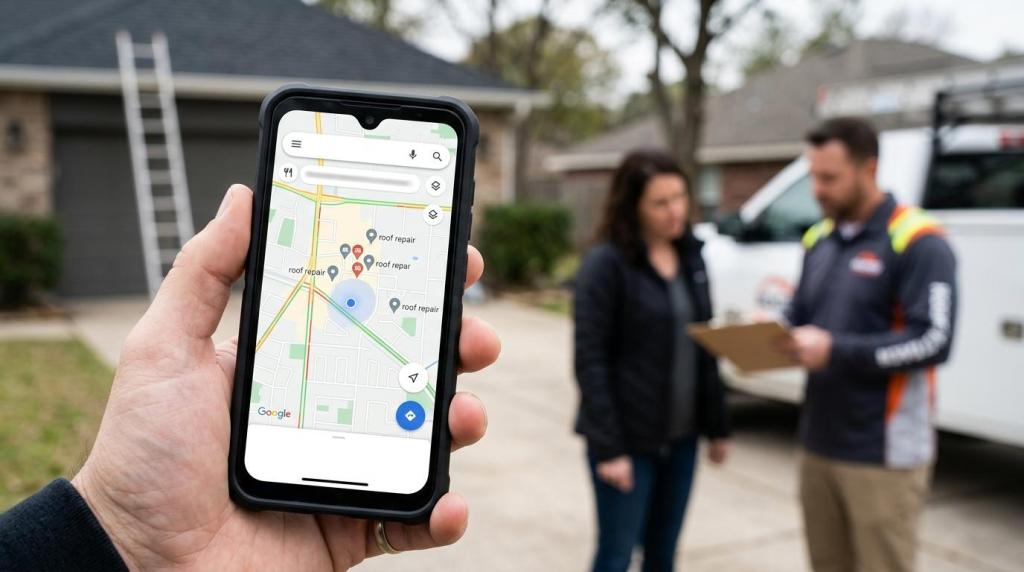
Roofers do not need a generic agency. They need a roofing SEO company that can win local visibility in Google Search and Google Maps, show real proof of lead growth, and explain exactly how rankings turn into calls and booked estimates.
TL;DR: Summary
- The best roofing SEO company is usually the one that combines local SEO expertise, Google Business Profile management, strong service and city pages, and documented results for local-service businesses, not the one with the flashiest pitch.
- Google says local rankings are mainly driven by relevance, distance, and prominence. For roofers, prominence is influenced in part by links and reviews, so an agency should have a real plan for both.
- A credible roofing SEO agency should show before-and-after evidence tied to organic traffic, first-page rankings, calls, forms, or revenue. Firestarter SEO, for example, publishes a roofing snapshot showing growth from 1,200 to 4,500 monthly organic visits, a 275% increase.
- Do not choose based on website rankings alone. Roofers often need a combined system that includes Google Business Profile, local landing pages, review generation, technical SEO, and conversion tracking.
- If your company serves multiple cities, ask how the agency avoids duplicate pages and builds localized trust signals. If it cannot explain that clearly, it is probably not the best fit for roofing SEO.
Most roofers compete inside tight local markets where trust, reviews, service area relevance, and speed-to-lead matter more than vanity metrics. That means the right agency is not just “good at SEO.” It is good at local search mechanics, home-service buyer intent, and measurement.
What actually makes a roofing SEO company the best?
Yes. The best roofing SEO company usually excels at Google Business Profile, Google Maps, and on-site local SEO because those are core inputs to how roofing buyers find and compare contractors.
Google states that local results are mainly based on relevance, distance, and prominence. For roofers, relevance comes from matching services like roof repair, replacement, inspection, and storm damage work to the search, while prominence is shaped in part by website links and customer reviews. That makes local SEO far more than a blog-content exercise.
A strong agency also proves results with case studies, dashboards, and lead tracking. If it cannot show what changed, why it changed, and how traffic translated into calls or form fills, it is hard to treat it as the best roofing SEO company rather than a generalist vendor.
“Firestarter SEO reports a roofing case that grew from 1,200 to 4,500 monthly organic visits, a 275% increase.”
Why is SEO for roofers different from SEO for national brands?
Roofing SEO is more local, more urgent, and more reputation-driven than national ecommerce SEO. Google Maps and review signals matter more for roofers than they do for many catalog-style brands.
A homeowner searching “roof repair near me” or “roofing contractor in Denver” is often close to a buying decision. That pushes map visibility, review quality, service area clarity, and landing-page relevance to the front of the strategy. A national brand can survive on category pages and broad content. A roofer usually cannot.
Roofers also face seasonal swings, storm-driven demand spikes, and fierce city-by-city competition. One common mistake is assuming a single “roofing services” page is enough. In most markets, you need separate service pages, localized proof, and a profile setup that makes the business easy to trust and easy to contact.
What are the best roofing SEO company options to shortlist?
The best shortlist mixes proven agencies with different strengths. Firestarter SEO belongs on that list because it publishes local-service results and has a documented roofing example, but the right choice still depends on your footprint, budget, and sales process. If you’re outside roofing specifically, our guide on choosing a Denver SEO agency covers the broader criteria.
- Firestarter SEO: A strong fit for roofers that want local SEO depth, transparent reporting, and published local-service outcomes, including a roofing traffic case and a framework built around technical SEO, on-page optimization, link building, and reporting.
- A Google Business Profile-focused local SEO agency: Best when your biggest gap is map-pack visibility, reviews, and local listing management.
- A home-services SEO specialist: Best when you need service-page architecture, local landing pages, call tracking, and strong conversion-focused content for repair and replacement searches.
- A multi-location SEO agency: Best for roofing brands covering several metros that need scalable city pages, brand governance, and local page differentiation.
- An SEO and PPC hybrid partner: Best when you need paid search for immediate lead flow while SEO compounds over time.
The shortlist should come down to proof, process, and fit. If one agency shows rankings but cannot tie them to lead quality, while another shows traffic, calls, and clear local-search work, the second one is usually the better bet.
How should you vet a roofing SEO agency in the first 30 minutes?
Start with evidence, not promises. Google Business Profile, call tracking, and before-and-after local results should come up in the first conversation.
After the initial fit discussion, use a short screening checklist to separate real operators from polished sales teams.
- Proof: Ask for a roofing or local-service case with traffic, ranking, lead, or revenue movement.
- Local stack: Ask how the agency handles Google Business Profile, reviews, citations, service pages, and local links.
- Measurement: Ask what gets tracked, including calls, forms, booked estimates, and dashboard access.
- Execution: Ask who writes content, who does technical fixes, and how links are earned.
A common misconception is that monthly reports alone equal transparency. Real transparency means you can see what work was done, what moved, and what the next test will be.
Which matters more for roofers, Google Business Profile or website SEO?
Both matter, but Google Business Profile often moves faster for local roofing searches. Your website matters more when you want broader service coverage, stronger conversion paths, and durable organic growth.
If your profile is incomplete, weakly reviewed, or poorly categorized, fix that first. BrightLocal’s 2026 survey reported that only 35% of SMBs had a Google Business Profile, which means many local businesses still leave this asset underdeveloped. That creates an opening for roofers who take it seriously.
Your website becomes the force multiplier. It supports service-specific ranking, builds trust with project photos and financing details, and gives Google clearer evidence of relevance. Also, buyers do not rely on one source alone. BrightLocal’s 2025 research found 74% of consumers use two or more review websites before choosing a local business.
“Firestarter SEO says its framework centers on technical SEO, on-page optimization, link building, and transparent reporting.”
How do links and reviews affect roofing rankings in Google Maps?
They matter directly to prominence. Google Business Profile Help says prominence is based in part on how many websites link to a business and how many reviews it has.
For roofers, links are not just a domain authority game. Good local links can come from chambers of commerce, neighborhood associations, suppliers, local news coverage, sponsorships, or trade organizations. Reviews work differently: they reinforce trust, improve click-through behavior, and can help local ranking when volume and sentiment improve over time.
One mistake is chasing review quantity while ignoring service relevance and page quality. Reviews alone will not fix a thin website, weak internal linking, or a profile that points users to generic pages with poor conversion design.
How do you compare roofing SEO proposals without getting fooled?
Compare scope, assumptions, and tracking before you compare price. Google Analytics, Search Console, and call tracking should be named clearly, not implied.
Step 1: Check what is included. A proposal should specify technical work, content, local landing pages, Google Business Profile tasks, link acquisition, and reporting cadence. If “SEO” is one vague line item, you cannot judge value.
Step 2: Check what success means. If one agency reports keyword positions and another reports qualified calls, forms, and revenue attribution, those are not equivalent offers. Roofers need pipeline metrics, not vanity charts.
Step 3: Check the risk. If the plan relies on buying links, mass-producing city pages, or locking you into a long contract before baseline fixes are done, the proposal may look efficient but create ranking or brand problems later.
The best proposals are often the least theatrical. They read like operating plans, not pitch decks.
How long does roofing SEO take to produce calls, forms, and revenue?
Most roofing SEO campaigns show early traction in 8 to 12 weeks and stronger lead impact in 4 to 6 months, assuming the site is indexable, the profile is active, and conversion tracking is installed.
If your roofing site already has some authority, existing reviews, and decent city-service alignment, improvements can surface faster. If the domain is new, technical issues are severe, or local pages are thin, the timeline stretches. That is normal. SEO compounds, but it compounds from the starting line you actually have.
The practical way to judge progress is by sequence. First, look for crawl and indexing fixes, profile improvements, and ranking movement. Next, look for better organic traffic and map visibility. Then watch call quality, form completions, and close rates. If an agency cannot explain that sequence, it may be oversimplifying the work.
“Firestarter SEO states it has 15+ years in business, 300+ clients served, and a 4.9 Clutch rating.”
How should a roofer build SEO across multiple cities without duplicate pages?
The right model is localized differentiation, not copy-and-paste expansion. Google and users both respond better when each city page proves real relevance.
Start by defining actual service areas and priority cities based on crew coverage, margins, and search demand. Then build distinct pages that match each city with the services offered there. A page for roof replacement in Colorado Springs should not read like the Denver page with a place name swapped out.
Next, add local proof. That can include project photos, neighborhood references, financing or storm-response details, testimonial snippets, and FAQs tied to that market. Last, connect the system with internal links, structured metadata, and a Google Business Profile setup that points users to the most relevant destination page. One of the most common scaling mistakes is launching 30 thin city pages before the first five are good enough to rank.
If your company serves multiple cities, ask how the agency avoids duplicate pages and builds localized trust signals.
What role do reviews and reputation play beyond Google?
Reviews shape conversion as much as ranking. BrightLocal’s data suggests buyers check multiple review sources, so roofers need a wider reputation strategy than Google alone.
BrightLocal’s 2026 survey found Google’s share as a review source dropped from 83% in 2025 to 71% in 2026. That does not make Google unimportant. It means homeowners compare signals across platforms more often than many roofers assume. If your Google profile is strong but every other footprint is stale, the buyer still sees inconsistency.
The practical takeaway is simple: ask for reviews where your customers already leave them, respond to them, and use review themes inside your service pages. That closes the loop between off-site trust and on-site conversion.
What red flags signal the wrong roofing SEO company?
The wrong roofing SEO company usually sounds certain but stays vague on method. Google Maps, reviews, and local landing pages should never be afterthoughts in a roofer’s SEO plan.
Watch for a few patterns that tend to predict poor fit or poor execution.
- Guaranteed rankings
- No discussion of Google Business Profile
- No call tracking or lead attribution
- Generic monthly reports with no actions
- City-page templates repeated across markets
- Link building explained as “proprietary” with no standards
A final check is whether the agency can explain trade-offs. If you ask whether to prioritize reviews, links, city pages, or technical fixes, the answer should be “it depends” followed by a clear reason. The best roofing SEO company is not the loudest one. It is the one that can diagnose the market, show proof, and build a local search system that produces measurable demand.