

Imagine this: Two years ago, a home services contractor moved his business to a new location across town. He updated his website and Google Business Profile and told his regular customers. He even printed new business cards.
What he didn’t do was update the 14 directory listings, 3 data aggregators, and a handful of local news mentions that still listed his old address. His rankings in the local Map Pack began to slip within weeks. By the time he connected the dots, he’d dropped out of the top three entirely for his most valuable keywords.
Nobody warned him that changing his address without updating every mention of it across the internet would quietly lower his local search visibility. Nobody told him that Google would look at fifteen different sources saying fifteen slightly different things about where his business was located and decide it wasn’t confident enough to recommend him prominently.
That’s what NAP inconsistency looks like in real life. And it happens to local businesses all the time.
This guide explains exactly what NAP consistency means, why Google treats it as a trust signal, where it needs to be consistent, and how to fix it when it isn’t.
What NAP Consistency Actually Means
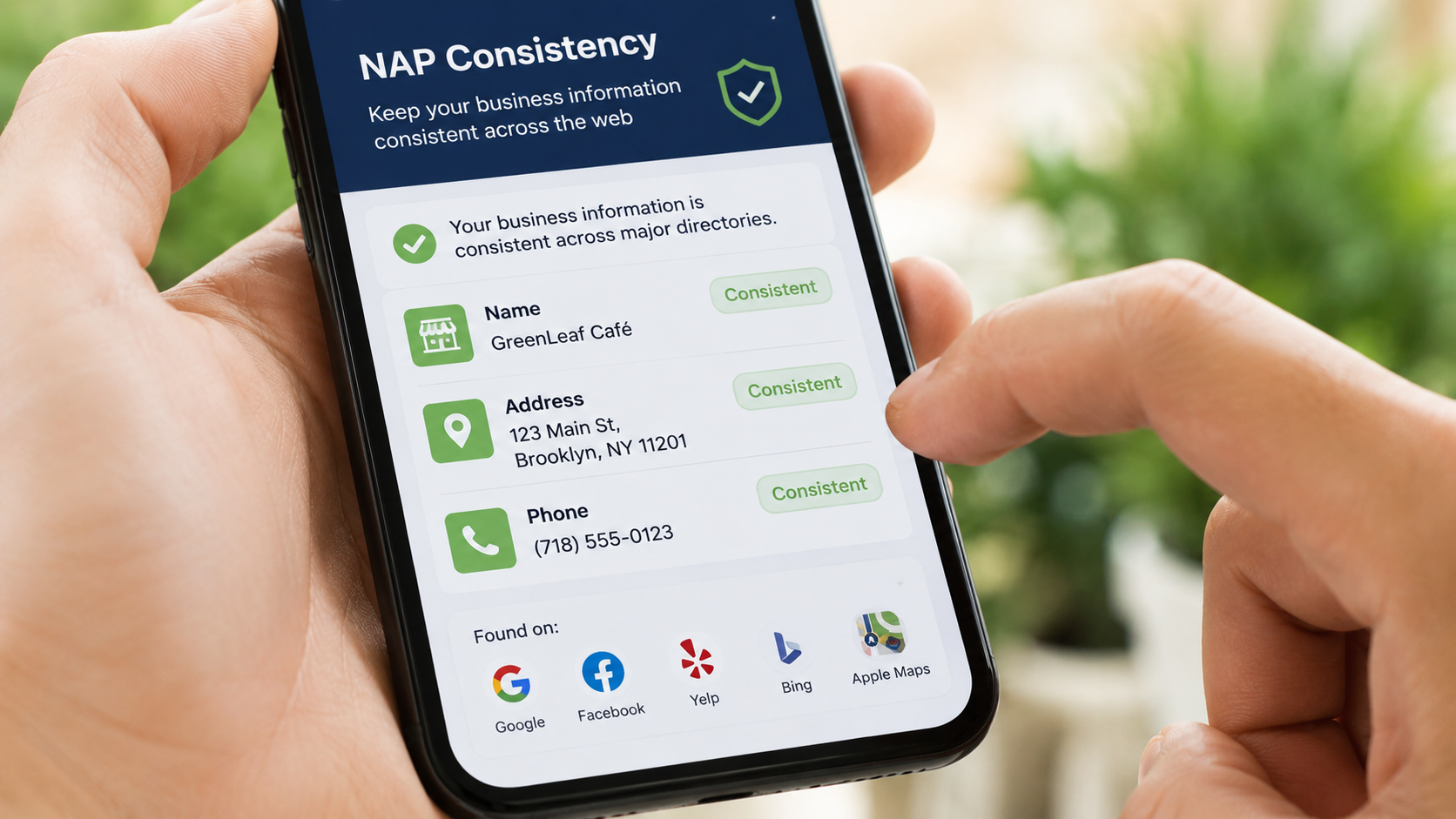
NAP consistency is the practice of ensuring your business Name, Address, and Phone number appear in exactly the same form across every online source where your business is listed. NAP stands for Name, Address, and Phone number — the three core pieces of identifying information Google uses to verify that your business is legitimate, stable, and located where you claim.
Not roughly the same. Not close enough for a human to figure out they’re the same business. Exactly the same. Character for character.
This is where most business owners underestimate the problem. They assume Google is smart enough to figure out that “Denver Plumbing Co.,” “Denver Plumbing Company,” and “Denver Plumbing Co” (no period) are all the same business. And in some ways, Google is smart enough to figure that out. The problem is that conflicting versions still create uncertainty in the algorithm’s confidence scoring, and lower confidence means lower rankings.
Think of it this way: if you asked five people for the same person’s phone number and got five slightly different answers, how confident would you feel about which one was right? Google doesn’t offer the option to call to check. It scores confidence based on consistency, and inconsistency costs you.
NAP consistency is one component of a broader local SEO strategy. For the complete framework, including Google Business Profile optimization, local citations, on-page signals, and local link building — read our full guide: The Complete Local SEO Guide for Small Business: How to Rank in Your City in 2026. Understanding how NAP fits into the full picture makes the fixes in this article easier to prioritize.
Why Google Cares So Much About NAP
Google’s local search algorithm is fundamentally a trust verification system. Before it recommends your business to someone searching nearby, it wants to be confident that your business is real, that it’s where you say it is, and that the contact information it shows to searchers is accurate.
One of the primary ways Google builds that confidence is by cross-referencing your business information across multiple independent sources. Your Google Business Profile says your address is 456 Oak Avenue, Suite 100, Denver, CO 80203. Your website says the same thing. Yelp says the same thing. Bing Places says the same thing. The local chamber of commerce directory says the same thing.
That pattern of agreement across independent sources tells Google that this business is consistently presenting the same information everywhere, which is what a legitimate, stable business does.
Now introduce inconsistency. Your GBP says “Suite 100.” Your website says “Ste 100.” Three directories say “Unit 100” because that’s how a data aggregator interpreted it years ago. One old directory still shows your previous address from before you moved. Your Facebook page shows a different phone number because you used a call tracking number when you set it up.
Google is now looking at six different versions of your business information across six sources, all of which should say the same thing. Its confidence in exactly where you are and how to contact you drops. And a less confident Google is a less generous Google when it comes to local rankings.
Research from Moz’s Local Search Ranking Factors survey consistently identifies citation consistency as a meaningful local ranking signal, particularly in competitive markets where the difference between ranking in the Map Pack and sitting just outside it can represent a dramatic difference in inbound call volume.
How NAP Inconsistency Damages Your Local Rankings
Here is the specific mechanism by which inconsistency affects your rankings.
It Dilutes Your Prominence Signals
Prominence is one of the three core signals Google uses to determine Map Pack rankings, alongside relevance and distance. Your citation footprint, the number of authoritative sources that mention your business, directly contributes to your prominence. But not all citations carry equal weight. A citation with accurate, consistent information contributes its full weight to your prominence score. A citation containing conflicting information carries less weight because Google can’t fully trust it as a corroborating source.
It Creates Proximity Confusion
Distance is another of Google’s three core local ranking signals. Google needs to know exactly where your business is located to determine how close it is to a given searcher. If your address appears in three different forms across your citation profile, Google faces a confidence problem: which version of your address is accurate? When Google isn’t certain about your location, your proximity advantage in your own neighborhood gets diluted. A competitor with a slightly less-optimized profile but perfectly consistent NAP data can outrank you for nearby searches because Google is more confident about their location.
It Breaks the Trust Chain
Every local citation is a data point in a chain of evidence Google uses to verify your business. A clean chain, where every source agrees, builds trust incrementally with each source. A broken chain, where sources conflict, doesn’t just stop building trust. It actively introduces doubt. And doubt in Google’s algorithm translates directly into lower ranking positions.
The Most Common NAP Inconsistencies and Where They Hide
Most NAP inconsistencies aren’t the result of carelessness. They happen for completely understandable reasons: businesses move, phone numbers change, companies rebrand, data aggregators scrape outdated information, and nobody thinks to audit every directory whenever something changes.
Here are the most common patterns.
- Business name variations. Your legal business name, the name on your signage, the abbreviated version your team uses, and the version a data aggregator pulled from an old source years ago can all differ. If they do, Google’s algorithm treats them as separate strings of text.
- Address format differences. “Street” vs “St.” vs “St” (no period). “Suite” vs “Ste” vs “Ste.” vs “#.” “Avenue” vs “Ave.” vs “Ave” (no period). “North” vs “N.” These seem trivial, but they’re not — especially when an algorithm compares text strings across sources looking for consistency.
- Old addresses from previous locations. Every time a business moves, it leaves a trail of old addresses across every directory in which it has ever been listed. Data aggregators, which automatically distribute your information to hundreds of downstream directories, may still be pushing your old address through that network years after you moved. Updating your GBP and your website is only the beginning.
- Multiple phone numbers. A landline, a mobile number, a tracking number used in a specific ad campaign, and a number that used to belong to the business and got recycled to someone else. All of these can appear in different listings depending on when and how each one was created.
- Duplicate listings. Many businesses have multiple listings on the same platform without realizing it. One was created automatically by the platform. Another was created by the business owner who didn’t know the first one existed. A third was suggested by a customer. Each duplicate is its own set of NAP data that may differ from the others.
- Inconsistent business categories. This isn’t strictly NAP, but category inconsistencies across directories reduce your relevance signals, compounding the damage from NAP issues.
Where Your NAP Needs to Be Consistent
NAP consistency isn’t just about the big directories. It’s a web standard that needs to hold across every place your business information appears.
- Your Google Business Profile. This is the anchor. Everything else should match it. Get this right first, then use it as the reference standard for everything else. Learn how to Fully Optimize Your Google Business Profile in 2026
- Your website. Your business name, address, and phone number should appear in your website’s footer, your contact page, and any location-specific pages. The format needs to match your GBP exactly. Your website is one of the sources Google uses to verify your GBP information.
- Major directories. Yelp, Bing Places, Apple Maps, Facebook Business, TripAdvisor, and the relevant industry-specific directories for your business type. These carry the most authority and get checked most frequently by Google. If you’re based locally, our list of Denver business directories and citations covers the regional sources worth prioritizing too.
Data aggregators. Data Axle, Localeze, and Foursquare are the three major aggregators that automatically push your business information to hundreds of downstream directories. If your information is incorrect at the aggregator level, it gets propagated incorrectly across a large portion of your citation ecosystem. If it’s right, that correctness propagates just as widely.
- Social media profiles. Your Facebook Business page, LinkedIn company page, Instagram business profile, and any other social platforms where your business is present. These are sources Google references, and they need to match.
- Unstructured citations. Local news articles, community blogs, sponsorship pages, and other web mentions of your business. You have less control over these, but they still factor into your citation profile. When you spot inaccuracies in unstructured citations, contacting the site owner to request a correction is worth the effort.
NAP Consistency for Businesses That Have Moved or Rebranded
Moving locations or rebranding creates the most complex NAP situation a local business faces, because historical inconsistency compounds across every directory that was ever created for your old information.
When you move, the priority order is the same as above, but the urgency is higher. Every day your old address sits in major directories is another day Google’s confidence in your location is being undermined.
Start with your GBP and website on the day of the move. Get those corrected first because they’re the sources Google checks most frequently. Then move through data aggregators and major platforms as quickly as possible.
For rebrands, the challenge is that your old business name may still be embedded in dozens of listing URLs and page titles that you can’t change — only claim and update the content of. Focus on the fields you can control: the business name, address, and phone number in every listing you can access.
One practical tip: document your complete citation profile before you move or rebrand. Create a spreadsheet listing every directory your business appears in, along with the login credentials for each. That list makes the update process dramatically faster and more complete.
If you’ve already moved or are managing a multi-location business, Firestarter SEO’s local SEO service includes a full citation audit and cleanup for every local engagement. We map every instance of your business information across the web, identify every inconsistency, and systematically correct them — starting with the sources that carry the most ranking weight.
Frequently Asked Questions About NAP Consistency
1. How long does it take for NAP corrections to improve my local rankings?
After correcting your major platforms and data aggregators, most businesses start to see positive movement in local rankings within six to twelve weeks. The timeline depends on how quickly Google recrawls the corrected sources and how widespread the inconsistencies were. Corrections to your Google Business Profile and website take effect fastest, typically within days to weeks. Data aggregator corrections take longer to propagate through downstream directories, which is why addressing the aggregators early in the process matters.
2. Does my NAP need to be consistent on social media profiles?
Yes. Google references social profiles — particularly Facebook Business pages — as part of its business verification process. Your business name, address, and phone number on every social platform where your business is present should exactly match your Google Business Profile. This includes LinkedIn company pages, Instagram business profiles, and any other platform where your business maintains a presence. Treating social profiles as separate from your local SEO strategy is one of the most common gaps in citation audits.
3. My business name legally includes “LLC” but I never use it in marketing. Which version should I use?
Choose one version and use it consistently everywhere. Many businesses opt for the version without the legal suffix for readability, which is fine — as long as that’s the version used across every listing and your Google Business Profile. The version you choose matters less than the consistency with which you apply it. Once you’ve standardized on one form, update every listing that uses a different variation.
4. Can NAP inconsistency get my Google Business Profile suspended?
Inconsistency itself does not trigger suspensions. Suspensions are caused by specific guideline violations, such as keyword stuffing in your business name, a suspicious address, or listing a business at an ineligible location. However, widespread NAP inconsistencies can prompt Google to request reverification of your listing, temporarily limiting your profile’s functionality. The more significant risk is not suspension but the steady erosion of local ranking positions that inconsistency produces over time.
5. What is NAP in local SEO?
NAP in local SEO refers to the Name, Address, and Phone number of a business as they appear across the internet. NAP consistency is the practice of ensuring that these three pieces of information are identical across all online sources — your website, Google Business Profile, directories, social profiles, and data aggregators. Google uses your NAP data as a verification signal: when all sources agree, Google gains confidence that your business is legitimate and located where you claim. When sources conflict, Google’s confidence drops, and your local rankings suffer.
Not sure how consistent your NAP data is across the web? Firestarter SEO’s local SEO audit maps every instance of your business information online, identifies every inconsistency, and tells you exactly what to fix and in what order. Request your free audit here or contact our team directly to talk through your local search situation.