

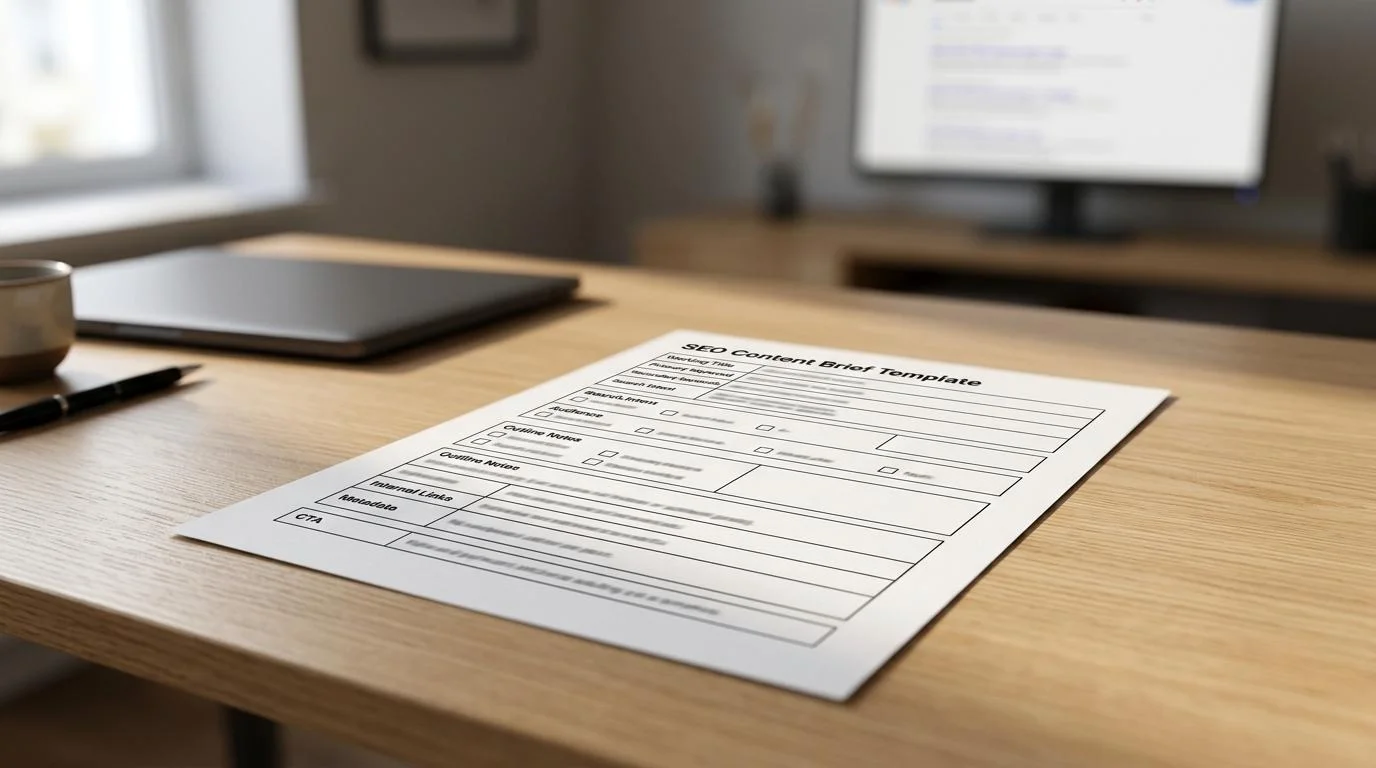
A strong article usually starts ranking long before the first draft is written.
It starts with the brief.
When an SEO content brief is vague, writers guess. They guess the audience, the search intent, the angle, the keywords, the structure, and the goal. That guesswork creates slow production, heavy revisions, and content that sounds polished but misses the search opportunity.
A writer-proof SEO content brief fixes that. It gives clear direction without turning the assignment into a script. The best briefs tell a writer what the page needs to achieve, who it needs to help, and what must be covered to compete in search.
Why SEO content briefs matter for rankings and content quality
A content brief is not just a project handoff. It is the strategic layer between keyword research and finished content.
That matters because search performance depends on fit. The page has to match the query, satisfy intent, cover the right subtopics, and move readers toward a next step. If any of those pieces are missing, even strong writing can underperform.
Teams usually feel the cost of a weak brief in familiar ways:
- missed search intent
- inconsistent brand voice
- bloated drafts
- repeated revision cycles
- weak internal linking
- unclear calls to action
The opposite is also true. A precise brief gives writers confidence. Editors spend less time fixing structure. SEO teams spend less time retrofitting keywords and headings after the draft is done. The content arrives closer to publish-ready, and the page has a better shot at ranking for the terms it was built to target.
What makes an SEO content brief writer-proof
Writer-proof does not mean rigid. It means the instructions remove ambiguity.
A useful brief answers five questions right away: What keyword are we targeting? What does the searcher want? Who is reading? What should the page cover? What action should happen after the page is read?
It also protects the writer from silent expectations. If a team wants a transactional angle, a formal tone, a 1,500-word range, three internal links, and a custom meta description, that should be in the brief, not in an editor’s head.
The strongest briefs usually include these elements:
- Primary keyword: the main phrase the page targets
- Secondary keywords: close variants, supporting terms, and related questions
- Search intent: informational, commercial, transactional, or mixed
- Audience profile: who the reader is and what problem they need solved
- Content angle: the specific promise or framing of the piece
- Outline structure: required H2s, H3s, and topic notes
- On-page SEO notes: title tag, meta description, URL, internal links
- CTA goal: the next action the reader should take
That list looks simple. In practice, it is what separates content that ranks with purpose from content that just fills space.
SEO content brief template sections that actually help writers
A template only works if it is practical. If it is too thin, writers still guess. If it is too dense, nobody uses it well.
The sweet spot is a one-page or two-page document with essential inputs, examples, and no fluff. Here is a template structure that works well for blog posts, service pages, and pillar content.
| Brief Section | What to Include | Example |
|---|---|---|
| Working title | Draft title tied to keyword and angle | SEO Content Brief Template for Marketing Teams |
| Primary keyword | One main target phrase | seo content brief template |
| Secondary keywords | Related phrases and subtopics | content brief example, SEO brief, writer instructions |
| Search intent | What the searcher wants | Informational, with light commercial intent |
| Audience | Reader role, sophistication, pain points | Marketing manager at an SMB who needs a repeatable process |
| Content goal | Business purpose of the page | Drive qualified traffic and lead readers to SEO services |
| Editorial angle | What makes this piece useful | Show how to create briefs that reduce revisions and improve rankings |
| Recommended length | Suggested range, not a fixed count | 1,300 to 1,700 words |
| Outline | Required H2s/H3s with notes | Include template, mistakes, process, and content-type variations |
| SERP notes | What top-ranking pages do well or miss | Most cover structure but skip workflow and QA details |
| Internal links | Pages that must be referenced | SEO services, content strategy, keyword research |
| External references | Trusted sources if needed | Google Search Essentials, industry studies |
| Metadata notes | title tag direction, meta description, slug | Put primary keyword near the front |
| CTA | What the reader should do next | Request a strategy call or download the template |
This kind of table gives writers both structure and context. It also creates consistency across a team without flattening every article into the same voice.
How to create an SEO content brief step by step
A good brief starts in the search results, not in a blank document.
Look at the top-ranking pages for the target keyword. What type of content is ranking? Are the results how-to guides, landing pages, templates, comparison posts, or product pages? That tells you what Google sees as the closest match for the query.
Then study the page patterns. What questions keep showing up? What subtopics are standard? Where are competitors thin, dated, or repetitive? Those gaps often become your angle.
A practical workflow looks like this:
- Pick the primary keyword and one clear page goal.
- Review the current SERP to confirm intent and format.
- Pull related questions, secondary keywords, and topic gaps.
- Define the audience and the stage of the buyer journey.
- Draft the outline with required sections and notes.
- Add on-page SEO instructions, links, and CTA details.
- Review the brief before assigning it to a writer.
That review step matters more than most teams think.
If a strategist cannot hand the brief to a new writer and expect a solid first draft, the brief is not ready. This is why many brands invest in SEO content brief services to standardize content production, reduce revisions, and improve ranking consistency.
Search intent and competitive analysis in an SEO content brief
Take a phrase like “seo content brief template.” The person searching is probably not ready to hire an agency on the spot. They want a format, examples, and a process they can use. A brief for that keyword should center on practical application, not a sales-heavy service pitch.
Competitive analysis helps refine that direction. You are not copying competitors. You are reading the market.
A brief should note points like these after SERP review:
- What ranks now: listicle, guide, template, landing page
- What competitors cover: common headings, FAQs, examples
- What they miss: workflow detail, audience nuance, CTA guidance
- What your page should do better: clearer template, stronger examples, tighter intent match
This gives the writer a realistic benchmark. It also helps the business avoid publishing another generic page that says the same thing as the top ten results.
SEO content brief template example you can reuse
A reusable template should be easy to scan. Writers should not need to hunt for the real assignment inside a long strategy memo.
Here is a clean format you can copy into Google Docs, Notion, or your project management tool.
SEO content brief template format
Page type: Blog post
Primary keyword:
Secondary keywords:
Search intent:
Target audience:
Funnel stage:
Content goal:
Primary CTA:
Recommended word count:
Draft deadline:
Internal links to include:
External sources to reference:
Suggested title tag:
Suggested meta description:
URL slug:
Content angle
Write this piece for:
- readers with this level of knowledge
- this business problem
- this desired outcome
Outline notes
Include these sections:
- H2:
- H2:
- H2:
- H3:
- FAQ section:
Writer instructions
Use clear language, short paragraphs, and direct examples. Put the primary keyword in the title, opening section, and at least one subheading if it fits naturally. Answer the main query early, then build depth.
That last sentence is a strong rule for many briefs: answer first, expand second.
Brand voice and audience details in SEO content briefs
Two pages can target the same keyword and still perform very differently because the voice is off.
If the audience is a small business owner, highly technical language may lose them. If the audience is an experienced in-house marketer, shallow explanations will feel thin. Briefs should state the audience clearly enough that the writer can calibrate depth, terminology, and examples.
This is where many briefs fail. They explain the keyword but not the reader.
Add a short audience block to every template. Keep it plain:
- Reader role: marketing manager, founder, local business owner
- Pain point: inconsistent content production, weak rankings, unclear process
- Knowledge level: beginner, intermediate, advanced
- Tone target: professional, confident, practical
That small addition tends to improve first drafts fast. It keeps the writing grounded in a real use case instead of a pile of SEO instructions.
On-page SEO instructions every content brief should include
Writers should not be left guessing about page-level SEO details.
Even if your editor or SEO specialist will finalize metadata later, the brief should still note what matters. That keeps the draft aligned from the start and reduces cleanup work before publishing.
A solid on-page section can include:
- title tag direction
- meta description notes
- URL slug
- H1 guidance
- internal link targets
- image notes
- schema needs, if relevant
This is also the right place to mention practical quality standards. Ask for descriptive headings. Ask for natural keyword use. Ask for citations when claims need proof. Ask for readability, not filler.
Those are not small editorial preferences. They directly affect how useful the finished page is for readers and search engines alike.
Common SEO content brief mistakes that waste time
Many briefs fail because they are either too vague or too crowded.
A vague brief says “write about local SEO” and leaves everything else open. A crowded brief dumps raw keyword exports, ten competitor links, a dozen disconnected notes, and no clear priority. Neither one helps the writer.
The most common problems are easy to spot:
- Too many keywords: one page cannot rank well for every variation
- No clear intent: the writer does not know whether to teach, compare, or sell
- Outline without context: headings exist, but the business goal is missing
- No CTA: the article gets traffic but does not move readers anywhere
- No SERP review: the content fights the wrong battle
If you fix those five issues, brief quality usually improves right away.
Adapting an SEO content brief template by content type
Not every page needs the same brief depth.
A blog post may need audience, intent, outline, and internal links. A pillar page usually needs more structure, broader topic coverage, and a stronger internal linking plan. A service page needs tighter conversion guidance and a clearer commercial angle.
The template should stay consistent, but the emphasis should shift.
For a blog post, lead with the question being answered. For a service page, lead with problem, solution, and CTA. For a pillar page, lead with topic breadth, subtopic hierarchy, and supporting page relationships.
That consistency matters for scale. Teams move faster when every brief looks familiar, even when the page goals differ.
A reliable SEO process is rarely about producing more words. It is about giving the right writer the right instructions at the right level of detail. When the brief does its job, the draft has momentum from the first paragraph, and ranking becomes a result of planning, not luck.